Taking Back Control?. States and State Systems After Globalism, Hardback
416
Pagini
2024
An
Hardcover
Copertă
Descriere
The era of hyperglobalization once hailed as the 'end of history' was characterised by boundless capitalist expansion. The neoliberal revolution gave rise to a politics of scale aimed at the centralization and unification of states and state systems: the replacement of national with global governanc...
The era of hyperglobalization once hailed as the 'end of history' was characterised by boundless capitalist expansion. The neoliberal revolution gave rise to a politics of scale aimed at the centralization and unification of states and state systems: the replacement of national with global governance or, in Europe, of the nation-state with a supranational superstate, the European Union.
The 'New World Order' proclaimed by the United States in the wake of the Soviet collapse proved to be ungovernable by democratic means. Instead, it was ruled through a combination of technocracy and mercatocracy, failing spectacularly to provide for political stability, social legitimacy and international peace. Marked by a series of economic and institutional crises, hyperglobalization gave rise to various kinds of political countermovements that rebelled against and ultimately stopped the upward transfer of state authority in its tracks.
This book analyses the ongoing tug-of-war between the forces of globalism and democracy, of centralization and decentralization, and unification and differentiation of states and state systems, and how they are tied to the advance of global capitalism and the prospects for its social and democratic regulation. Exploring the possibility for states and the societies they govern to take back control over their collective fate, the book is an attempt at a renewed theory of the state in political economy. Inspired by the work of Karl Polanyi and John Maynard Keynes, it discusses the potential outlines of a state system allowing for democratic governance within and peaceful cooperation between sovereign nation-states.
Conectează-te pentru a lăsa o recenzie
Nicio recenzie încă
Fii primul care lasă o impresie.
Mai multe de Wolfgang Streeck
Vezi toate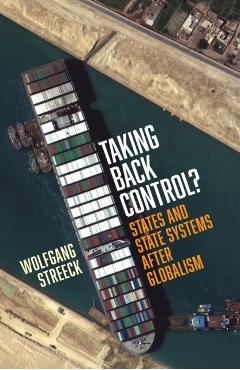
Taking Back Control?

Political Economy of Modern Capitalism
Buying Time

How Will Capitalism End?
How Will Capitalism End?

Critical Encounters: Capitalism, Democracy, Ideas, Hardcover

Democracy at Work - Contract, Status and Post-Industrial Justice, Paperback

Marea Regresie: de ce sa traim un moment istoric