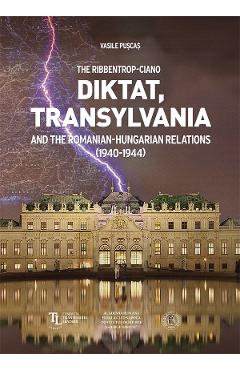
The Ribbentrop-Ciano Diktat, Transylvania and the Romanian-Hungarian Relations
374
Pagini
2021
An
Paperback
Copertă
Cartepedia
Cel mai bunActualizat 1 lună în urmă
37.90
Lei
Librariadelfin
Actualizat 10 ore în urmă
79.29
Lei
Librarie
Actualizat 2 săptămâni în urmă
95.10
Lei
Bookzone
Actualizat 1 zi în urmă
102.50
Lei
Libris
Actualizat 4 zile în urmă
105.72
Lei
Descriere
Editorial project published under the aegis of ”George Baritiu” Institute of History, The Romanian Academy and Transylvania Leaders Foundation. Translated from the Romanian by Doina-Elisabeta Mihalcea Cover design: Ciprian Butnaru First Cover Artwork: Foreign Affairs Ministers of Germany and Italy, ...
Editorial project published under the aegis of ”George Baritiu” Institute of History, The Romanian Academy and Transylvania Leaders Foundation. Translated from the Romanian by Doina-Elisabeta Mihalcea Cover design: Ciprian Butnaru First Cover Artwork: Foreign Affairs Ministers of Germany and Italy, Galeazzo Ciano and Joachim von Ribbentrop, at Belvedere Palace in Vienna The Contemporary History collection is coordinated by Prof. Vasile Pușcaș, PhD. However, since 1943, the Chancelleries of Moscow, London, Washington have been more and more concerned with Transylvania. In most cases, the interest of the Great Powers has been to maneuver Central European states on the basis of territorial aspirations, sometimes hidden under the slogan of "minority rights". Transylvania continued to be seen as a territory of compensation! In fact, the case of German-Italian "arbitration" and "mediation" in the Transylvanian issue (1940-1444) had less to do with the real rights of any minority (except perhaps of the German minority), because the population of Transylvania has experienced all the sufferings, from the nightmare of mass murders (Romanians in Northern Transylvania), to refugees, expulsions, loss of property and unimaginable frustrations, as evidenced by the reports of the two German-Italian joint commissions inserted in this volume. Moreover, it contributed to the aggravation of the relations between Romania and Hungary, with consequences for them and for this part of Europe still insufficiently revealed by the historiographical investigation. At the end of World War II, both the Westerners and the Soviets reached the common conclusion that a better ethnic border between Romania and Hungary than the one drawn by the Trianon Treaty was not possible. But this decision came after a huge historical tragedy experienced by Transylvanian inhabitants (Romanians, Hungarians, Jews, Germans, etc.) between 1940 and 1944. It was a traumatic experience both for the Romanian and Hungarian population. (Vasile Pușcaș)
Conectează-te pentru a lăsa o recenzie
Nicio recenzie încă
Fii primul care lasă o impresie.
Mai multe de Vasile PUȘCAȘ
Vezi toate
Romania 1918. Marea Unire

Negociind cu Uniunea Europeana - Volumul VI - Comunicarea publica si negocie ...

Negotiating with the European Union - Volume II - The initial position paper ...

Negociind cu Uniunea Europeana - Volumul V - Pregatirea mediului de negocier ...

Negociind cu Uniunea Europeana - Volumul I - Documente initiale de ...

Negociind cu Uniunea Europeana - Volumul IV - Pregatirea mediului ...

Managing Global Interdependencies

Relatii Internationale/Transnationale
Teme europene
Romania si Uniunea Europeana. Post-Tratatul de la Lisabona