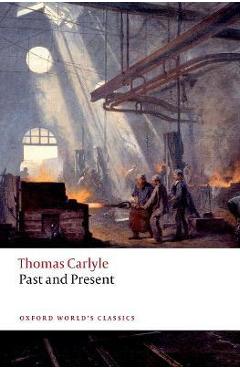
Past and Present - Thomas Carlyle
512
Pagini
2023
An
Brosata
Copertă
Descriere
Thomas Carlyle's Past and Present (1843) was a prophetic warning of impending disaster for mid-Victorian Britain that was delivered in what the author described as a 'miraculous thunder-voice, from out of the centre of the world.' The impact of Carlyle's social criticism was immediate and profound, ...
Thomas Carlyle's Past and Present (1843) was a prophetic warning of impending disaster for mid-Victorian Britain that was delivered in what the author described as a 'miraculous thunder-voice, from out of the centre of the world.' The impact of Carlyle's social criticism was immediate and profound, shaping debate about the 'The Condition of England' question well into the twentieth century and beyond, and serving as the moral foundation of the welfare state. His relentlessly abrasive and illuminating critique of industrial civilization generated a vast range of response both in England, Europe, and the United States. The writings of Matthew Arnold, John Stuart Mill, William Morris, John Henry Newman, and John Ruskin, as well as Henry David Thoreau, Ralph Waldo Emerson, and Walt Whitman, were saturated with imagery and ideas directly indebted to the book.
Past and Present also provided novelists and poets with an enduring vision of the ubiquitous rot that lay at the heart of 'laissez-faire' England. The repercussions of Carlyle's unique analysis can be witnessed in the literary form and thematic content of such works as Charles Dickens's Christmas Carol (1843), Dombey and Son (1848), Bleak House (1852-53), and Hard Times (1854); Benjamin Disraeli's Sybil (1845); Elizabeth Gaskell's Mary Barton (1848) and North and South (1855); and Charles Kingsley's Alton Locke (1850). Poets such as Alfred Tennyson in Maud (1855), Elizabeth Barrett Browning in Aurora Leigh (1856), and Arthur Hugh Clough in The Latest Decalogue (1862) built a vocabulary that was steeped in the outrage and indignation of Carlyle's polemic. The artist Ford Madox Brown attempted in his painting Work (1852-65) to give visual testimony to the profound social schisms that Carlyle had exposed in Past and Present and to pay tribute to the 'Sage' who had 'moulded a nation to his pattern.'
Conectează-te pentru a lăsa o recenzie
Nicio recenzie încă
Ai citit cartea? Fii primul care lasă o recenzie!
Mai multe de Thomas Carlyle
Vezi toate
Goethe's Wilhelm Meister's Apprenticeship, Books 1-6
Oliver Cromwell's Letters and Speeches: With Elucidations.; Volume V
The French Revolution: A History
The French Revolution: A History
Goethe
The Works Of Thomas Carlyle: Critical And Miscellaneous Essays
Critical and Miscellaneous Essays: Collected and Republished
The Works of Thomas Carlyle
Fraser's Magazine; Volume 67
The Correspondence of Thomas Carlyle and Ralph Waldo Emerson, 1834-1872