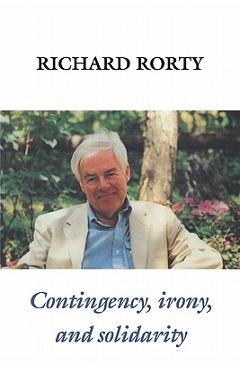
Contingency, Irony, and Solidarity
201
Pagini
1989
An
Paperback
Copertă
Descriere
In this book, major American philosopher Richard Rorty argues that thinkers such as Nietzsche, Freud, and Wittgenstein have enabled societies to see themselves as historical contingencies, rather than as expressions of underlying, ahistorical human nature, or as realizations of suprahistorical goals...
In this book, major American philosopher Richard Rorty argues that thinkers such as Nietzsche, Freud, and Wittgenstein have enabled societies to see themselves as historical contingencies, rather than as expressions of underlying, ahistorical human nature, or as realizations of suprahistorical goals. This ironic perspective on the human condition is valuable but it cannot advance Liberalism's social and political goals. In fact, Rorty believes that it is literature and not philosophy that can do this, by promoting a genuine sense of human solidarity. Specifically, it is novelists such as Orwell and Nabokov who succeed in awakening us to the cruelty of particular social practices and individual attitudes. Thus, a truly liberal culture would fuse the private, individual freedom of the ironic, philosophical perspective with the public project of human solidarity as it is engendered through the insights and sensibilities of great writers. Rorty uses a wide range of references--from philosophy to social theory to literary criticism--to elucidate his beliefs.
Conectează-te pentru a lăsa o recenzie
Nicio recenzie încă
Fii primul care lasă o impresie.
Mai multe de Richard Rorty
Vezi toate
Philosophy As Poetry
CONTINGENTA, IRONIE SI SOLIDARITATE

What's the Use of Truth?
Rorty and Pragmatism
Truth and Progress: Philosophical Papers, Richard Rorty (Author)

La ce bun adevarul?
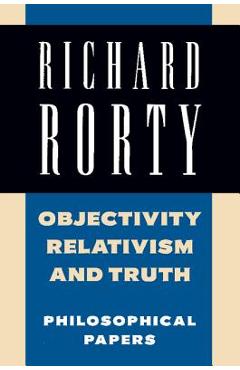
Objectivity, Relativism, and Truth: Philosophical Papers

Consequences of Pragmatism: Essays 1972-1980, Paperback

Viitorul religiei

What Can We Hope For?. Essays on Politics, Paperback