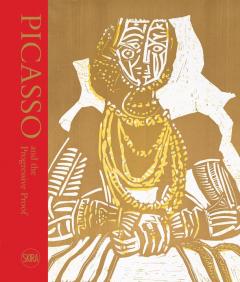
Picasso and the Progressive Proof
128
Pagini
2023
An
Hardcover
Copertă
Descriere
On the 50th anniversary of Picasso's (1881–1973) death, a book devoted to the progressive proofs by the leading Spanish master.
On the 50th anniversary of Picasso's (1881–1973) death, a book devoted to the progressive proofs by the leading Spanish master.
While there has been considerable interest in Pablo Picasso’s late work over the past several decades, and some of that interest directed at the artist’s work in the linoleum print medium, there remains much to discover regarding this aspect of his prodigious printmaking activities, and specifically on the role played by the progressive proof. There has been an uptick in the acquisition of these sets of proofs by museums and private collectors over the past twenty years but exhibitions and published accounts have lagged behind.
With this present project we examine for the first time in depth a particularly illuminating set of eight progressive proofs made by Picasso and his printer Hidalgo Arnéra for the artist’s first published linocut, the so-called Cranach II (Baer 1053; 1958). The first in a series in the medium of linoleum block prints (after a singular effort in 1939), Picasso created the first Portrait of a Young Girl after Cranach the Younger in two colors and in the same orientation as the Cranach original on 3 July 1958. The following day he commenced making five different linoleum blocks – bistre or grayish brown, yellow, red, blue and black – to be superimposed on each other in that order and in reverse of the original, the Cranach II print. He then proceeded to print different proofs, in the process making two different states of the color blocks and three of the black in order to arrive at the final image.
This event touched off a decade of work in linocut (or linoleum block) printmaking, inspired by the South of France, where the artist had increasingly worked since the 1940s. Speaking to the artist’s love affair with the region, he begins a series of linocuts depicting the bullfight. Nine proofs for the Pique II (1959) attest to this; the series completed by the finished print.
Conectează-te pentru a lăsa o recenzie
Nicio recenzie încă
Fii primul care lasă o impresie.