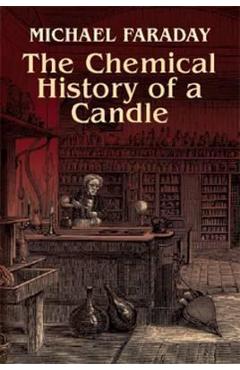
The Chemical History of a Candle
240
Pagini
2003
An
Paperback
Copertă
Descriere
One of the greatest experimental scientists of all time, Michael Faraday (1791-1867) developed the first electric motor, electric generator, and dynamo -- essentially creating the science of electrochemistry. This book, the result of six lectures he delivered to young students at London's Royal Inst...
One of the greatest experimental scientists of all time, Michael Faraday (1791-1867) developed the first electric motor, electric generator, and dynamo -- essentially creating the science of electrochemistry. This book, the result of six lectures he delivered to young students at London's Royal Institution, concerns another form of energy -- candlelight.
Faraday titled the lectures "The Chemical History of a Candle," choosing the subject because, as he explained, "There is not a law under which any part of this universe is governed which does not come into play and is not touched upon during the time a candle burns]."
That statement is the foundation for a book that describes, with great clarity, the components, function and weight of the atmosphere; the function of a candle wick; capillary attraction; the carbon content in oxygen and living bodies; the production of carbon dioxide from coal gas and sugar; the properties of carbonic acid; respiration and its analogy to the burning of a candle; and much more. There is also a chapter comprising Faraday's "Lecture on Platinum."
A useful classroom teaching tool, this classic text will also appeal to a wide audience interested in scientific inquiry.
Conectează-te pentru a lăsa o recenzie
Nicio recenzie încă
Fii primul care lasă o impresie.
Mai multe de Michael Faraday
Vezi toate
The Chemical History of a Candle
The Chemical History of a Candle
Great Minds Series
Experimental Researches in Electricity
Faraday's Experimental Researches in Electricity
Experimental Researches in Electricity
Faraday's Experimental Researches in Electricity
Experimental Researches in Electricity
The Chemical History of a Candle: A Course of Lectures Delivered before a Juvenille
The Chemical History of a Candle: A Course of Lectures Delivered before a Juvenille