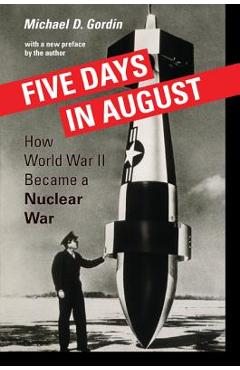
Five Days in August: How World War II Became a Nuclear War
232
Pagini
2015
An
Paperback
Copertă
Descriere
Most Americans believe that the Second World War ended because the two atomic bombs dropped on Japan forced it to surrender. Five Days in August boldly presents a different interpretation: that the military did not clearly understand the atomic bomb's revolutionary strategic potential, that the Alli...
Most Americans believe that the Second World War ended because the two atomic bombs dropped on Japan forced it to surrender. Five Days in August boldly presents a different interpretation: that the military did not clearly understand the atomic bomb's revolutionary strategic potential, that the Allies were almost as stunned by the surrender as the Japanese were by the attack, and that not only had experts planned and fully anticipated the need for a third bomb, they were skeptical about whether the atomic bomb would work at all. With these ideas, Michael Gordin reorients the historical and contemporary conversation about the A-bomb and World War II.
Five Days in August explores these and countless other legacies of the atomic bomb in a glaring new light. Daring and iconoclastic, it will result in far-reaching discussions about the significance of the A-bomb, about World War II, and about the moral issues they have spawned.
Conectează-te pentru a lăsa o recenzie
Nicio recenzie încă
Fii primul care lasă o impresie.
Mai multe de Michael D Gordin
Vezi toate
A Well-Ordered Thing: Dmitrii Mendeleev and the Shadow of the Periodic Table, Revised Edition

Einstein in Bohemia

On the Fringe: Where Science Meets Pseudoscience

How Reason Almost Lost Its Mind: The Strange Career of Cold War Rationality, Paperback

Scientific Babel, Paperback

Pseudoscience: A Very Short Introduction, Paperback