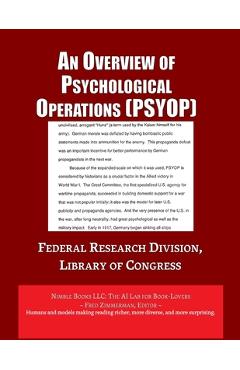
Analysis of Psychological Operations (PSYOP)
60
Pagini
2024
An
Paperback
Copertă
Descriere
A professional snapshot of the state of the federal government's knowledge of psychological warfare at the end of the Cold War.
A professional snapshot of the state of the federal government's knowledge of psychological warfare at the end of the Cold War.
This document written by the Federal Research Division of the Library of Congress for an unnamed federal agency provides a comprehensive overview of psychological operations (PSYOP) with a specific focus on military applications in the context of the Cold War era (up to November 1989). Key Points: -Definition of PSYOP: The document clarifies the evolving definition of PSYOP, from influencing enemy attitudes in wartime to a broader scope encompassing peacetime activities aimed at shaping emotions, attitudes, and behaviors of foreign groups to achieve political and military objectives. -Historical Context: The paper explores historical examples of PSYOP, highlighting instances like Judith and Holofernes, Ghengis Khan, and the American Revolution, showcasing the enduring value of psychological tactics in warfare. -Soviet PSYOP: The document delves into the Soviet Union's extensive and sophisticated PSYOP machinery, emphasizing their philosophy of constant ideological warfare against the capitalist world. It details the roles of various Soviet agencies like the International Department, Propaganda Department, and the KGB in conducting active measures and disinformation campaigns. -United States PSYOP: The paper examines the US approach to PSYOP, characterized by a historical reluctance towards peacetime PSYOP and a reactive posture. It discusses the challenges faced by the US in countering Soviet propaganda and the need for improved coordination and resources. -Evolving Landscape: The document acknowledges the changing nature of warfare, with the rise of unconventional conflicts and low-intensity conflicts, necessitating a greater emphasis on PSYOP. Strengths of the Document: -Comprehensive Overview: The paper provides a well-structured and informative analysis of PSYOP, covering historical examples, theoretical frameworks, and contemporary applications. -Comparative Approach: The document effectively compares and contrasts the Soviet and US approaches to PSYOP, highlighting their strengths and weaknesses. -Emphasis on Contemporary Challenges: The paper acknowledges the changing nature of warfare and the increasing importance of PSYOP in the context of unconventional and low-intensity conflicts. Potential Limitations: -Dated Information: As the document predates November 1989, it does not consider the significant geopolitical shi
Conectează-te pentru a lăsa o recenzie
Nicio recenzie încă
Fii primul care lasă o impresie.
Mai multe de Library of Congress
Vezi toate
Researching French Local History and Genealogy

Journeys: Young Readers' Letters to Authors Who Changed Their Lives: Library of Congress Center for the Book

The Records of the Virginia Company of London Volume; Volume 4

The Records of the Virginia Company of London Volume; Volume 4

The Records of the Virginia Company of London Volume; Volume 2

The Records of the Virginia Company of London Volume; Volume 2

The Records of the Virginia Company of London Volume; Volume 1

The Records of the Virginia Company of London Volume; Volume 1

The Records of the Virginia Company of London Volume; Volume 3

The Records of the Virginia Company of London Volume; Volume 3