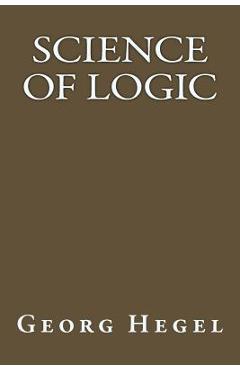
Science Of Logic - Georg Wilhelm Friedrich Hegel
170
Pagini
2017
An
Paperback
Copertă
Descriere
In the Science of Logic, Hegel sets out to show that the process by which consciousness assimilates objects into mental concepts is more dynamic and, one might say, messier then Kant describes it. Just as he does in the Phenomenology, Hegel traces here the movement of consciousness, or the idea, fro...
In the Science of Logic, Hegel sets out to show that the process by which consciousness assimilates objects into mental concepts is more dynamic and, one might say, messier then Kant describes it. Just as he does in the Phenomenology, Hegel traces here the movement of consciousness, or the idea, from basic categories to more complex ones. Consciousness attempts to grasp objects at a most basic level, finds this first attempt somehow unsatisfying as exposing inadequacies or contradictions, and proceeds to a higher level, and so on. In the Phenomenology and elsewhere, Hegel seems to imply that this dialectical unfolding is an inherent feature of the world we inhabit, governing history and culture. In Logic we see that the dialectic is a phenomena of ideas. But the two dimensions of reality (i.e., history, culture, and the world in general) and our ideal, mental, or conceptual grasp of things are not really separable. The world we live in is a world created by ideas. But our ideas do not emanate from the mind of a single individual, as other idealists such as Kant seem to imply. Concepts have an objective status. They exist outside of any individual as taken-for-granted reality. They belong to common cultural understanding.
Conectează-te pentru a lăsa o recenzie
Nicio recenzie încă
Ai citit cartea? Fii primul care lasă o recenzie!
Mai multe de Georg Wilhelm Friedrich Hegel
Vezi toate
Lectures on the Philosophy of History

Philosophy Of Right

Prelegeri de istoria filozofiei. Volumul II: Platon. Aristotel. Filozofia el ...

Prelegeri de istoria filozofiei. Volumul I: Introduceri. Filozofia inainte d ...
Viata lui Iisus

Jenaer Systementwürfe II: Logik, Metaphysik, Naturphilosophie - Georg Wilhelm Friedrich Hegel

Cours D'esthétique; Volume 3

Cours D'esthétique; Volume 3
The Philosophy of Art: Being the Second Part of Hegel's Aesthetik, in Which are Unfolded Historically the Three Great Fundamental Phases of the Art-activity of the World: Translated, and Accompanied With an Introductory Essay Giving an Outline of the

The Philosophy of Art: Being the Second Part of Hegel's Aesthetik, in Which are Unfolded Historically the Three Great Fundamental Phases of the Art-activity of the World: Translated, and Accompanied With an Introductory Essay Giving an Outline of the