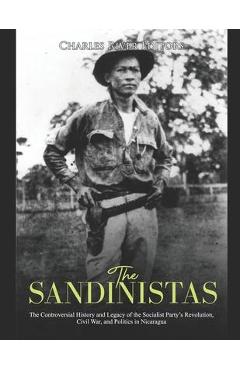
The Sandinistas: The Controversial History and Legacy of the Socialist Party's Revolution, Civil War, and Politics in Nicaragua
52
Pagini
2020
An
Paperback
Copertă
Descriere
Includes pictures
-
Includes pictures
-
Includes a bibliography for further reading
"I will not abandon my resistance until the . . . pirate invaders . . . assassins of weak peoples . . are expelled from my country. ... I will make them realize that their crimes will cost them dear. . . . There will be bloody combat. . . Nicaragua shall not be the patrimony of Imperialists. I will fight for my cause as long as my heart beats. ... If through destiny I should lose, there are in my arsenal five tons of dynamite which I will explode with my own hand. The noise of the cataclysm will be heard 250 miles. All who hear will be witness that Sandino is dead. Let it not be permitted that the hands of traitors or invaders shall profane his remains." - Augusto César Sandino
For much of the 20th century, Latin American governments in large part lived under a system of military junta governments. The mixture of indigenous peoples, foreign settlers and European colonial superpowers produced cultural and social imbalances into which military forces intervened as a stabilizing influence. The proactive personalities of military heads and the rigid structures of such a hierarchy guaranteed the "strong man" commanding officer an abiding presence in the form of executive dictator. Such leaders often bore the more collaborative title of "President," but the reality was, in most cases, identical. Likewise, the gap between rich and poor was often vast, and a disappearance of the middle class fed a frequent urge for revolution, reenergizing the military's intent to stop it. With no stabilizing center, the ideologies most prevalent in such conflicts alternated between a federal model of industrial and social nationalization and an equally conservative structure under privatized ownership and autocratic rule drawn from the head of a junta government.
Whichever belief system was in play for the major industrial nations of Central and South America, a constant bombardment of foreign influence pushed the people of states such as Nicaragua, Chile, Brazil, Argentina, and others toward overthrow, in one direction or the other. To the left came Stalinist influences from the Soviet Union and Castro's Cuba, while the German World War II model and an anti-communist mindset from the United States worked behind the scenes to upset any movement toward extreme liberalism. The tacit acceptance of these right-wing dictators across South America was part of an overarching effort known as Operation Condor, co
Conectează-te pentru a lăsa o recenzie
Nicio recenzie încă
Fii primul care lasă o impresie.
Mai multe de Charles River Editors
Vezi toate
French Legends: The Life and Legacy of Jean-Paul Marat

Rhodes: The History and Legacy of the Greek Island from Ancient Times to Today

The Underground City of Derinkuyu: The History and Mystery of the Ancient Subterranean City in Turkey
Native American Tribes: The History and Culture of the Shoshone
The Rise of Constantinople: The Ancient History of the City that Became the Byzantine Empire's Capital

Crusader Castles: The History of the Medieval Castles Built in the Holy Lands during the Crusades

Antioch: The History and Legacy of the Ancient Syrian City Established by the Seleucid Empire
The Avars and Magyars

The Mystery of the Lady Be Good: The History of the World War II Plane's Disappearance and Discovery

Liver-Eating Johnson: The Life and Legacy of the Famous Mountain Man