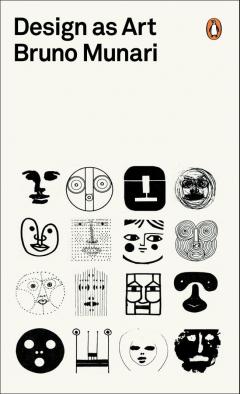
Bruno Munari: Circle, Square, Triangle
280
Pagini
2015
An
Paperback
Copertă
Descriere
Circle: "God is a circle whose center is everywhere but whose circumference is nowhere." Circle means perfection, cyclicity, superiority of the divinity, but also instability and movement. In nature soap bubbles are spherical and internal trees' rings are circular; the legend tells that Gi...
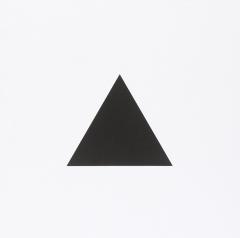
Circle: "God is a circle whose center is everywhere but whose circumference is nowhere." Circle means perfection, cyclicity, superiority of the divinity, but also instability and movement. In nature soap bubbles are spherical and internal trees' rings are circular; the legend tells that Giotto drew a perfect O, while perfection is tangible on Michelangelo's Tondo Doni and Botticelli's Vergine col Bambino. King Arthur's knights were pairs around a round table, and nowadays people sit in circle to make a decision or watch a show. Bruno Munari selects and describes in this little, extraordinary encyclopedia, several uses of this fascinating and mysterious form, unstable and hieratic at the same time. Square: Square has much importance in man's life: a lot of churches, monuments, games (like chess), and fonts are square-based. But man seems not to realise it...one more time Bruno Munari amazes us with an historical, anthropological, scientific square book. Triangle: From the vegetable structure of the coconut to the diagram of human settlements by Le Corbusier, one can frequently find the shape of the equilateral triangle in many different occurrences, both in a natural environment and in artificial works. Along with the circle and the square, the equilateral triangle is one of the three basic forms, and is suitable to be combined in modular frameworks to generate a structured field in which endless other combinatorial forms may be constructed. From classical Arab and Japanese decorations to the contemporary architecture of Buckminster Fuller and Wright, the familiarity with the equilateral triangle, in all its formal and structural resources, generates curious and fascinating experimentations. After the books of the same collection dedicated to the circle and the square, a new reprint by Bruno Munari about the many uses of this evocative shape throughout the centuries. These studies were originally published in 1976 in the series Quaderni di design, curated by Munari himself for Zanichelli.
Conectează-te pentru a lăsa o recenzie
Nicio recenzie încă
Ai citit cartea? Fii primul care lasă o recenzie!