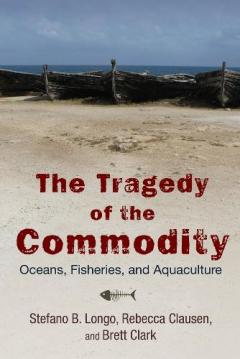
Tragedy of the Commodity
274
Pagini
2015
An
Paperback
Copertă
Descriere
Although humans have long depended on oceans and aquatic ecosystems for sustenance and trade, only recently has human influence on these resources dramatically increased, transforming and undermining oceanic environments throughout the world. Marine ecosystems are in a crisis that is global in scope...
Although humans have long depended on oceans and aquatic ecosystems for sustenance and trade, only recently has human influence on these resources dramatically increased, transforming and undermining oceanic environments throughout the world. Marine ecosystems are in a crisis that is global in scope, rapid in pace, and colossal in scale. In "The Tragedy of the Commodity," sociologists Stefano B. Longo, Rebecca Clausen, and Brett Clark explore the role human influence plays in this crisis, highlighting the social and economic forces that are at the heart of this looming ecological problem. In a critique of the classic theory "the tragedy of the commons" by ecologist Garrett Hardin, the authors move beyond simplistic explanations--such as unrestrained self-interest or population growth--to argue that it is the commodification of aquatic resources that leads to the depletion of fisheries and the development of environmentally suspect means of aquaculture. To illustrate this argument, the book features two fascinating case studies--the thousand-year history of the bluefin tuna fishery in the Mediterranean and the massive Pacific salmon fishery. Longo, Clausen, and Clark describe how new fishing technologies, transformations in ships and storage capacities, and the expansion of seafood markets combined to alter radically and permanently these crucial ecosystems. In doing so, the authors underscore how the particular organization of social production contributes to ecological degradation and an increase in the pressures placed upon the ocean. The authors highlight the historical, political, economic, and cultural forces that shape how we interact with the larger biophysical world. A path-breaking analysis of overfishing, "The Tragedy of the Commodity" yields insight into issues such as deforestation, biodiversity loss, pollution, and climate change.. Vezi mai mult Vezi mai mult
Inapoi in pagina de produs
Although humans have long depended on oceans and aquatic ecosystems for sustenance and trade, only recently has human influence on these resources dramatically increased, transforming and undermining oceanic environments throughout the world. Marine ecosystems are in a crisis that is global in scope, rapid in pace, and colossal in scale. In "The Tragedy of the Commodity," sociologists Stefano B. Longo, Rebecca Clausen, and Brett Clark explore the role human influence plays in this crisis, highlighting the social and economic forces that are at the heart of this looming ecological problem. In a critique of the classic theory "the tragedy of the commons" by ecologist Garrett Hardin, the authors move beyond simplistic explanations--such as unrestrained self-interest or population growth--to argue that it is the commodification of aquatic resources that leads to the depletion of fisheries and the development of environmentally suspect means of aquaculture. To illustrate this argument, the book features two fascinating case studies--the thousand-year history of the bluefin tuna fishery in the Mediterranean and the massive Pacific salmon fishery. Longo, Clausen, and Clark describe how new fishing technologies, transformations in ships and storage capacities, and the expansion of seafood markets combined to alter radically and permanently these crucial ecosystems. In doing so, the authors underscore how the particular organization of social production contributes to ecological degradation and an increase in the pressures placed upon the ocean. The authors highlight the historical, political, economic, and cultural forces that shape how we interact with the larger biophysical world. A path-breaking analysis of overfishing, "The Tragedy of the Commodity" yields insight into issues such as deforestation, biodiversity loss, pollution, and climate change..
Conectează-te pentru a lăsa o recenzie
Nicio recenzie încă
Fii primul care lasă o impresie.